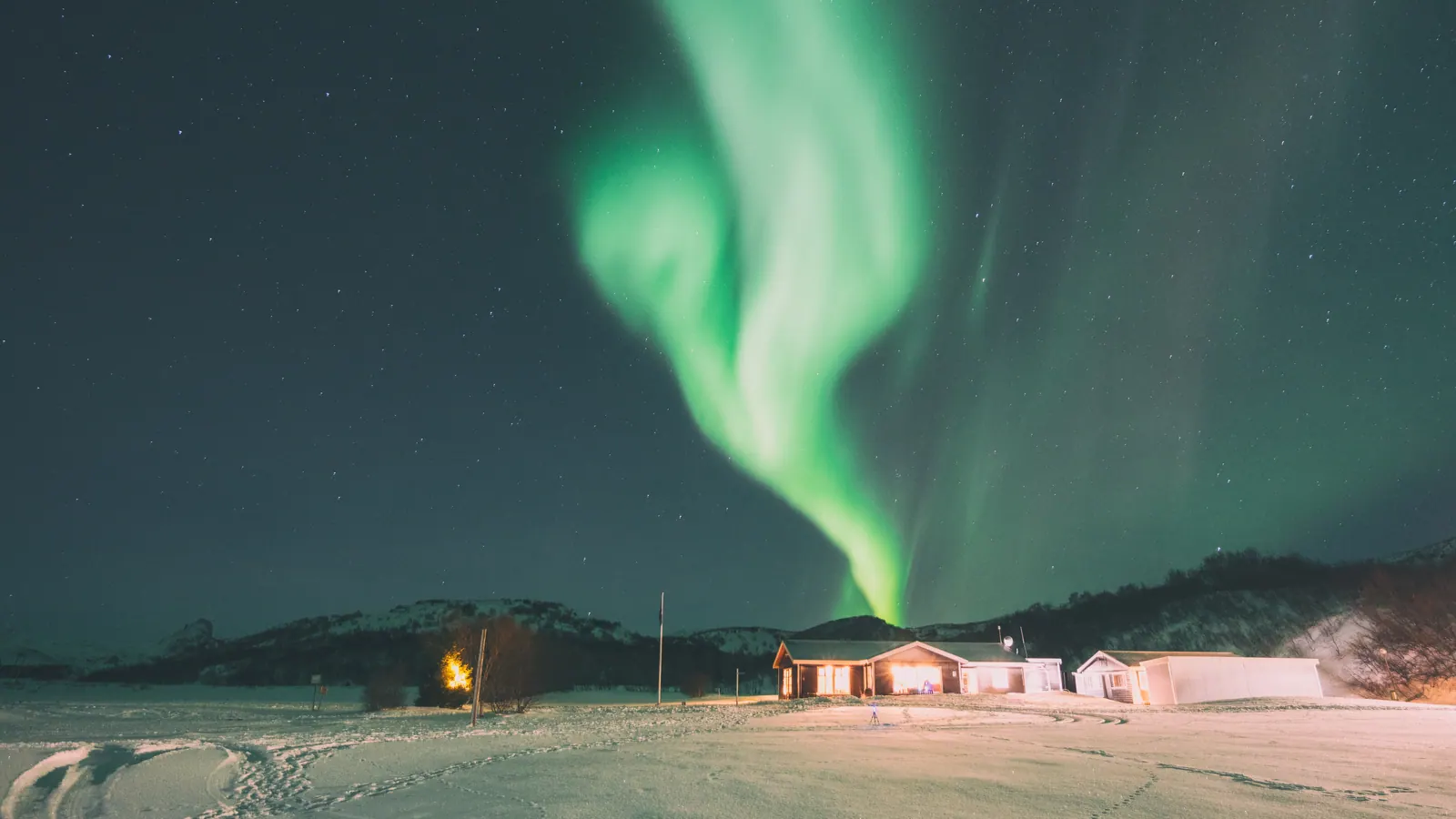

A high activity number behind an unbroken blanket of cloud is an excellent forecast for looking at cloud. Before you drive anywhere, ask two duller questions: will it be dark, and is there a realistic gap in the sky somewhere you can safely stand?
The evening gets much less frustrating once you stop treating the forecast as one score that promises a show.
Three things have to line up
You need darkness, a view through the cloud, and auroral activity that produces something visible from where you are. The Met Office’s aurora page puts the activity outlook beside a cloud forecast for exactly that reason.
A clear-looking map for the wrong hour will not help much, so move the cloud forecast to the time you will be outside and check your actual place. One detail is easy to miss: on that Met Office page, the sun, darkness, sunrise and moonrise timings are for Reykjavík. If you are elsewhere in the country, do not quietly reuse that clock.
Which green patch are you looking at?
On the Icelandic Met Office cloud map, green means cloud and white means clear sky. If a green patch is moving towards your town, it may soon cover the part of the sky you hoped to see. Check the selected cloud layer and hour. A white opening on the low-cloud map can still have cloud above it.
Now open NOAA’s short-term aurora map. The coloured oval shows where the model expects auroral activity. A green oval over Iceland and a green patch over your town on the Icelandic map can both be right. There may be a display above the clouds and very little to see from the ground.
NOAA’s model ordinarily looks about 30 to 90 minutes ahead when upstream solar-wind measurements are available. Read the valid time printed on the image. This is a map to consult after dinner while deciding whether to step outside. For a trip several weeks away, compare daylight and darkness for your travel dates.
What Kp can and cannot tell you
Kp describes geomagnetic activity on a scale from 0 to 9. It is not a percentage chance of a sighting above your hotel, it is not a brightness setting, and it knows nothing about clouds. NOAA’s planetary Kp explanation describes estimates for three-hour intervals, and a forecast and an estimate of observed activity are different products.
Iceland’s location makes low-Kp nights worth a look when everything else lines up. Higher activity can improve your chances, but it will not move a cloud or darken a summer night. So do not write off every low number, and do not keep driving in pursuit of a higher one.
Read the cloud forecast as a local one
Cloud cover changes from place to place and with height. Low, middle and high cloud percentages describe different layers, and they should not be added up into a total, since two layers can sit over the same patch of ground. For a combined view, use the explanation the service itself gives.
A forecast opening is a reason to look again closer to the time, and you should not treat it as a reservation. If every useful hour looks overcast, a comfortable evening near your accommodation may well beat chasing a hypothetical gap across the country.
Staying in the capital? Open Reykjavík’s northern lights forecast on Upperblue Fast and find “Darkness and cloud tonight.” Look for a break in the cloud during the dark hours you can actually spend outside. If the gap comes after you need to head home, even a promising activity forecast is little use that evening. For another town, choose a place in the aurora directory. BlueBlunder and Fast share an owner.
Give your eyes a fair chance
Pick a permitted place away from strong direct light and give yourself time. Cameras can pick up colour that is hard to see by eye. If yours turns a moving curtain into a green smudge, the phone photography guide shows how to check whether the phone or the curtain moved.
Expect to wait, and prepare for it: warm clothes, a charged phone, something to drink, and a separate torch or headlamp, since the phone you are navigating with makes a poor only light. Decide when you will stop as well as when you will start, because the tired drive back is part of the plan too.
Choose the parking before the sky
SafeTravel’s northern-lights guidance stresses designated parking, staying off the road, and care on unfamiliar ground in the dark. A beautiful display does not turn a narrow verge into a viewing area. Check the weather and official road information before leaving, and change the evening if they do not suit the trip.
For more help planning an evening, visit the northern lights collection. For the daytime side of the same trip, our weather-reading guide explains forecast clocks and source labels.